August 22, 2026 · 7 min read
3 Coin Wild Horse: What the Ta Ji Da Li Coins Are Actually Doing
We recorded a session of 3 Coin Wild Horse on TriLuck. The game is a 5x3, 243-way slot at 97% RTP with three coin pots that fill separately and a wild horse that nudges up the middle reels. Here is what each of those parts is really doing to the odds - and the one feeling the collector meters create that is not information.
We recorded a session of 3 Coin Wild Horse on TriLuck and put it on the channel. You can watch it here. It is ordinary footage of an ordinary session, which is exactly why it is worth walking through.
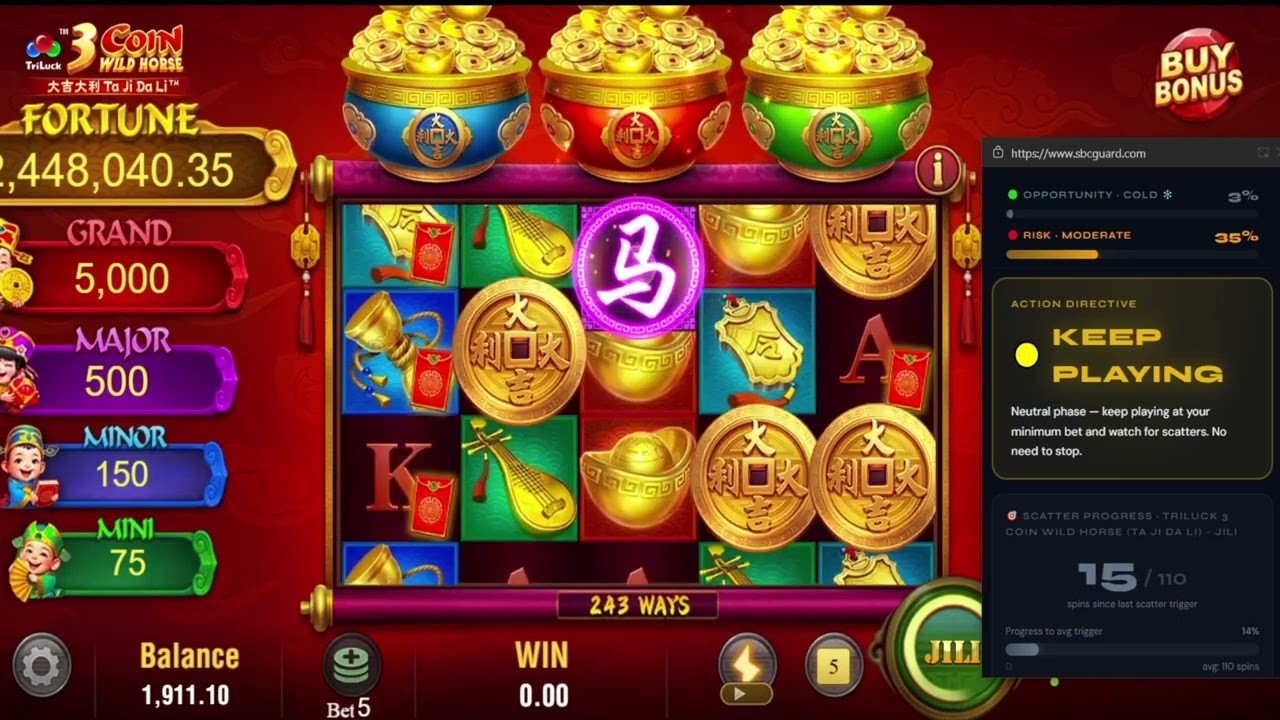
Most clips of this game are the moment a pot fills. This one is not about that. It is about the machinery underneath — because the machinery is the same on the spins that make a video and the thousands that do not.
The board, plainly
3 Coin Wild Horse is a TaDa Gaming slot released on 27 August 2025. The published figures:
- 5 reels, 3 rows, 243 ways to win — you win on adjacent reels from the left, not on drawn paylines.
- RTP 97% — genuinely high. The usual online range is 95–96%.
- Max win 2,000x your stake — a ceiling, not a target.
- Low to medium volatility — smaller swings than most of what sits next to it in a lobby.
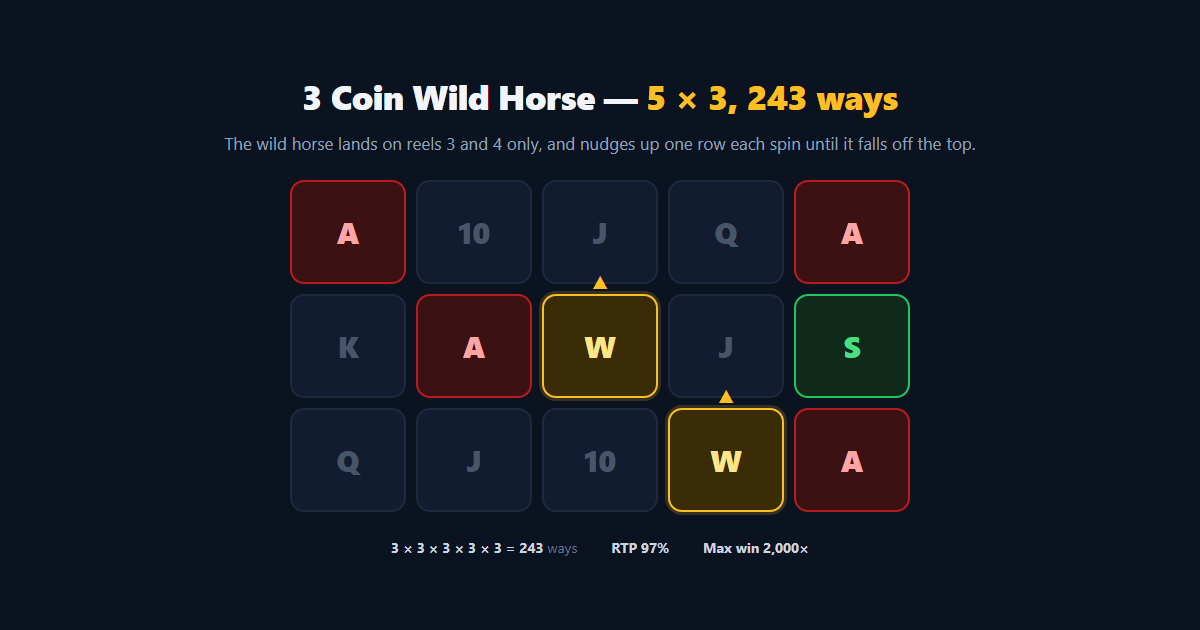
The 243 is not a marketing number. It is three symbol positions on each of five reels, multiplied out: 3 x 3 x 3 x 3 x 3 = 243. Every one of those routes is live on every spin, which is why the game pays small amounts often.
The horse is a base-game feature, and it is paid for by the base game
The wild horse is the mechanic the game is named for. It lands on reels 3 and 4 only, sticks, and nudges up one row every spin until it falls off the top. While it is there, it substitutes — so for a few spins the middle of the board is friendlier than it looks.
It is a good feature and it is genuinely fun to watch climb. It is also not free. A slot pays back what it pays back; a persistent wild that improves some spins is funded by every spin that does not have one. That is not a criticism of the design — it is just where the money for it comes from, and it is worth knowing that the generous-feeling stretch and the flat stretch are the same system.
Three pots, three different doors
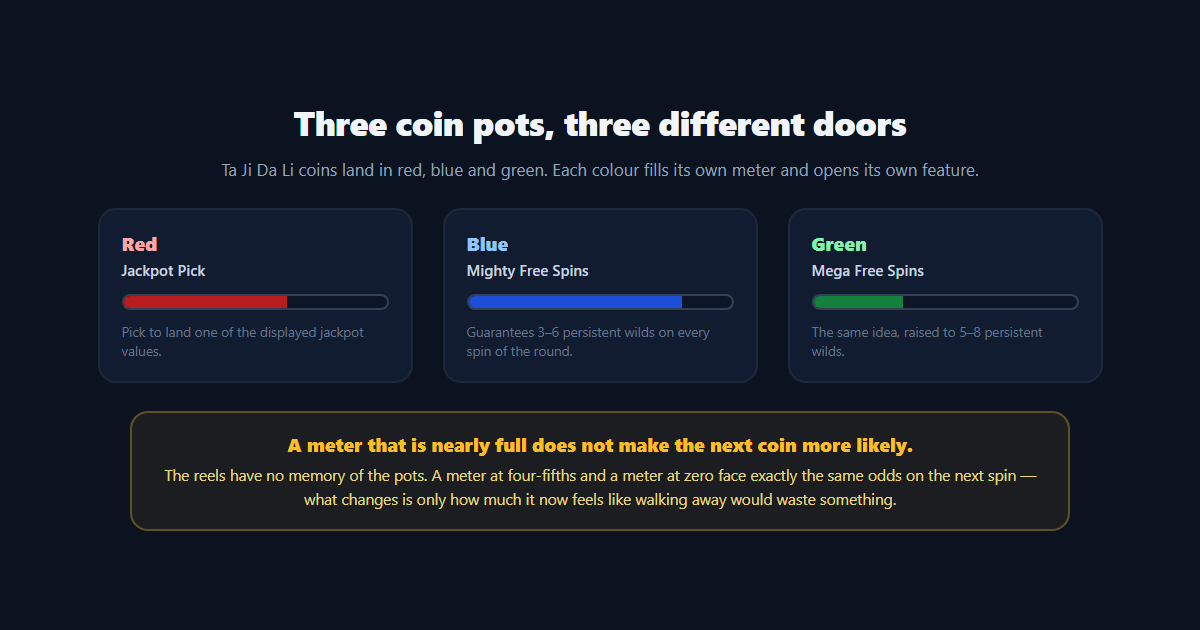
The coins in the title are the Ta Ji Da Li coins. They land in three colours and each colour fills its own meter above the reels, and each full meter opens a different thing:
- Red — the Jackpot Pick, where you pick to land one of the displayed jackpot values.
- Blue — Mighty Free Spins, which guarantee 3 to 6 persistent wilds on every spin of the round.
- Green — Mega Free Spins, the same idea raised to 5 to 8 persistent wilds.
There is a fourth thing that is easy to miss: the Red Envelope, which pays instantly when matching envelopes land on reels 1 and 5, anywhere from 3.8x to 888x the bet.
The part that is a feeling, not information
Here is the thing collector mechanics do, and 3 Coin Wild Horse does it three times over at once.
A meter that is nearly full looks like progress. It reads the way a loading bar reads, or a stamp card at a coffee shop: a few more and the thing arrives. That reading is wrong in one specific way, and the way matters. The reels have no memory of the pot. A meter at four-fifths and a meter at zero face exactly the same odds on the next spin. Nothing about the spin has changed.
What has changed is you. A partly-filled meter makes stopping feel like throwing something away — like the spins that filled it were a deposit you would forfeit. They were not a deposit. They were spins, and they are already spent, and the pot does not owe you anything for them.
The honest version of "so close"
A near-full meter is a picture of what already happened, not a forecast of what is about to. If you would not start playing right now at a fresh meter, the fact that this one is nearly full is not a reason to keep going — it only feels like one. This is the same wiring as the near-miss, and the near-miss is worth reading about on its own.
What 97% actually means for a session like the one in the video
97% is a real advantage over most of the lobby. It is also an average taken over an enormous number of spins, and it does not mean you keep 97% of what you sit down with.
Run it as an hourly cost instead, which is the number that matters for a session. The house edge is 3%. At 10 pesos a spin and a normal online pace of about 500 spins an hour, you are putting through 5,000 pesos of bets in that hour, and 3% of that is 150 pesos an hour as the expected cost of playing. On a 92% game the same hour costs 400 pesos. That is what a high RTP buys you: not winning, but a slower rate of losing — which is worth having, and is not the same thing.
The other half of it is bet size, which is the one lever you fully control. Double the stake and you double the hourly cost exactly. Nothing about the game changes; the meter fills at the same rate; only the price of watching it does. If you want that worked through properly, we did it in how long 1,000 pesos lasts on a slot.
And one thing worth checking before you play anywhere: the same game can ship at more than one RTP depending on the operator, which is its own strange story. The 97% above is the figure TaDa publishes for this title.
So what is the session in the video?
It is a real session on a well-made, high-RTP, low-volatility slot with a likeable horse and three meters that fill at their own pace. Nothing in it is rigged and nothing in it is a trick.
It is also a game that will happily take 150 pesos an hour from you at 10 a spin, forever, while showing you three progress bars that are not progress toward anything the reels can see. Both of those are true at once, and knowing the second one does not have to spoil the first.
If you want the board, the ways count and the feature list for this game in one place, it has a page in our game reference. And if you want to see the numbers on your own sessions rather than ours, that is what SBCGuard does.